I am now in the last term of my graduate program and really feeling the stress of looming deadlines. I don’t have the capacity to push myself, there is nothing more to push. My body not only protests, it also revolts! There is no option to push through, work harder, do more, suck it up…
I must be ready to submit my thesis for review by the end of this month, so it all needs to start coming together now! I really got off track with my project this summer when I lost tolerance to the computer that has been safe for me throughout my program. Something went wrong with the machine during the heatwaves and since then, it just runs hot all the time. The heat from the machine off gasses a fume that sets off my reactions. I spent the majority of my summer trying to find alternatives and experimenting with various borrowed laptops, and being sick from experimenting. Seriously. That is how I spent my summer. I finally settled into something that was working for me in the fall term, but that involved working outside in my three season room. Now that it is winter, it is not an option to work out there. Moving inside to work on a computer that makes me sick has been a bit of a nightmare actually. Losing tolerance to computers puts so much of what I CAN do, at risk. I use the computer to communicate, hold video conferences, write papers, write letters, read journal articles and books, attend classes and appointments. It is the tool that has allowed me to continue to be connected to the community, and to make a living. It has been heartbreaking for me to lose tolerance to it and it has made finishing my project very complicated and overwhelming. And now facing deadlines…
Oy!
You just can’t imagine (unless you live with this!)
My partner, who provides a great deal of both tangible and emotional support for me will be away during the month of January due to a family emergency. This means that I will working through this month, getting sick on the computer, and also having to manage our household alone. Luckily, I have amazing people in my life who are willing to help pick up groceries, run errands, do the shovelling, which will make a huge difference for me. I am extremely privileged to have that. Many people with ES/MCS do not have that, or some have had it in the past, but slowly lost their supportive community over the years. I recognize my priviledge in having a partner.
It has been a challenging time and will continue to be a challenging time. I could really use some extra support, boosts of confidence, love, and validation right now because I am not even actually sure I can do this thing that needs to be done.
The last 50 yards are always the hardest, I know – but this feels almost impossible. I am trying to be open to the prospect of failure and convincing myself that failure is a valid option, and so is “good enough”.
I am so ready to be moving forward. This year, I will need to continue to explore computers that I might be able to tolerate, or I will need to just give it up entirely. In some moments I feel relieved at the prospects of living my life without a computer, and other moments I feel horrified. My body really just needs a break from computers and maybe once all of this is done, my body will recover from these exposures and I will be able to continue use the computer as my access tool again in the future. That is my hope.
In the meantime, I need to buckle down and flesh out my chapters, manage my health, and maintain my nutrition. I need to work extra hard to take care of myself and listen carefully to what my body has to tell me. This will pass. My partner will return. I will finish this project and it will be ‘good enough’. I will not have to pay for an addional tuition and all of this will be behind me by spring!
I hope.

Showing posts with label thesis. Show all posts
Showing posts with label thesis. Show all posts
January 06, 2017
Computer Trouble

November 26, 2015
End of Coursework Reflection
I am in the home stretch of the coursework of my graduate program and I am having a lot of mixed feelings about it. It has been a long, hard road that has been deeply complicated by ES/MCS. A long strange trip, indeed.

I have one last policy paper to hand in and I am finished. I will still have another year of practicum and of course, my thesis. But I will not need to attend classes and subject myself to exposures that leave me incapacitated for days. There was a 9 month stretch last year, where I didn't have any in-person classes at all and my health improved tremendously. I have a great deal of hope about getting back to that place.
School was a good alternative to working, because I simply wasn't able to continue at my job after I acquired ES/MCS. It was impossible. Even with the various accommodations that I negotiated at work, it wasn't possible for me to continue to be employed. School allowed for flexibility in my schedule that made it possible for me to heal and recover. I was able to utilize telecommunications and Skype to attend lectures when I was unable to function. Once I was able to get a diagnosis (a year into my program) my accommodations increased tremendously, for example, air purifiers to my specifications were purchased for use in my classrooms. Diagnosis also made it possible to access a treatment protocol and I had a better sense of what was happening with my health. Eighteen months is a long time to be really really sick and have no idea why it is happening or how to get it under control.
In retrospect, being in grad school was the best option for me through my illness. The stakes are just not that high in grad school. Worst case scenario, you get a bad mark or have to rewrite a paper. In all of the jobs that I have ever had, the stakes have always been very high. I was employed in the field of social work for 12 years before going back to school. I was doing direct service/front line work and that is simply not an option for me anymore. Returning to school offered me the opportunity to develop new skills, update my theoretical knowledge base, and have a recovery-based educational sabbatical. I was not only exhausted and burnt out from my years of front line work, I was also profoundly sick and disabled by the neuro-immune symptoms of ES/MCS. My life, seemingly overnight, became very very small.
There has been a great deal of uncertainty for me in recent years as I move through my recovery. I am used to dreaming really big and working really hard and making things happen. I am used to being able to make a good salary and feeling independent. Managing expectations has been an important part of recovery for me, because the reality is that I am not the person that I was and my life has been altered in massive and significant ways. Finishing school and moving into the next stage of my life feels very uncertain for me, but I am better positioned with a fresh Masters of Social Work degree than I was with a 12 year old Honours degree in Psychology and Religion.
I am going to miss the classroom and the insights that I have gained. I am going to miss the conversations and social aspects of being with others who share my perspective. I am going to miss the Professors who inspired me and believed in me and encouraged me to stick with it when everything inside of me was begging me to just stay in bed and fade away. This illness has been very isolating for me. It has been a struggle to keep up with my readings and writing my papers when my brain function comes and goes like the wind and I have to spend days on end in the dark.
It is sort of a miracle that I made it through the coursework at all! Oy! I don't want to jinx myself - I do have one policy paper left and 200 hours of practicum AND MY THESIS left to do. I guess I shouldn't be too quick to attribute my success to a 'miracle'.
What is left for me to complete can all be completed from home, with the exception of some focus groups that I will be holding as part of my thesis research. I will not have to attend campus with any regularity and that is a huge relief for me. It will make it a lot easier to manage my life and my health. When I have a term with a class, I can't do anything outside of going to class. This results in four months of being homebound, having very minimal visitors, spending many days and nights incapacitated, and struggling to complete my readings, do my research and write my papers.
Nothing about going to the school has been easy. I had to negotiate a disability identity in order to access the accommodations that I required. This was a very confusing experience for me and I didn't always feel comfortable identifying as disabled, and yet, if I didn't I couldn't get the accessible learning and accommodations that I required in order to continue with my studies. In hindsight, I can say that perhaps grad school was also the best place to be negotiating a disability identity. I have had to negotiate many marginalized identities throughout my life and adding one more to the long list has not been easy. Social justice, critical and disability justice, transformative and environmental justice frameworks have really empowered me and provided me with theoretical tools to make sense of my experiences. School has been a relatively 'safe' place for me develop knowledge, practice skills, and expertise, while I recover from ES/MCS.
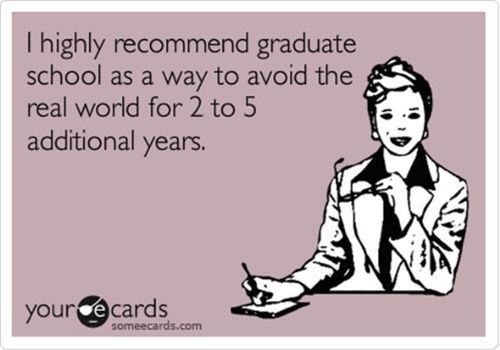
I have worked long enough in my life to know that grad school is not anything like the 'real world'. Not in any way. I recognize the privileged position of being a student and a researcher within an academic institution. As I move closer to the end of my program, my uncertainty about the future becomes increasingly salient. It took me five terms to figure out how to use my privilege as a student and how to be successful as a student and now it is all coming to an end. Out in the 'real world' my marginalized identities will be much harder to negotiate. I know this very well. I have no illusions about higher education.
Did I mention I was having mixed feelings?
Life as a student has become a sort of manageable way to live. I have a lot of access and equity support, and accommodations. I have been able to do research that interests me and is relevant to my life and my communities. I have been able to establish myself as an expert among academics and educate others about ES/MCS. School has helped me feel validated in my identities, even my marginalized ones.
I have to be perfectly honest and say that I have no idea what comes next. But I do know that it will not involve working inside of an hermetically sealed building with poor air quality and circulation.
And that is a reason to smile :)
June 08, 2015
2nd Year ES/MCS Anniversary Update
It was May 1, 2013
that I became TILTED and experienced the health crisis that I am still
recovering from. That first year was marked by body rebellion, full chaos and
profound uncertainty as I met with several specialists and underwent test after
test after test. I was flailing through day to day life in a dazed neurological
fog. I negotiated a number of necessary transitions during that first year. My
partner and I moved into a house that was safer than our previous apartment and
we worked very hard to completely detox our lives. I had to leave my job
because the building that made me sick became entirely intolerable to me. It
was not an option to continue to work, so I started graduate school. It was a
very confusing time and I was very isolated from family and friends. I was not
only housebound, but also mostly bedridden and unable to function for many
weeks and sometimes months at a time. I wasn’t sure if I was dying, or
what the hell was going on and no one else seemed to know either, including all
of the specialists I’d seen.

Our current medical
system is poorly equipped to deal with multi-system illness, nor is it equipped
to deal with the broad spectrum of illnesses that are arising as a result of
our increasingly toxic environment. New paradigms are emerging, but change is
always slow and we all know that matters related to the environment are not a
priority for our current government. And sadly, those of us at the front end of
this public health crisis are not going to get what we need from our family doctors
and until more research dollars are allocated to environmentally linked
illness, we will continue to be delegitimized. The good news is that the province has provided $560,000 to support annual fellowships over three years,
which we result in six new fellowships for family medicine graduates. This will
allow graduating physicians to take an extra year for training in Environmental
Health. This will translate to more health care for folks with
environmentally-linked illnesses in Ontario and it shows that the Federal Government is aware of this health issue and is at least starting to take steps
to address it. It gives me some hope.
The second year of my illness has been marked by
medical diagnosis, increased knowledge, healing, disability accommodation, and
moving towards finding joy in my ‘new normal’. I had 10 solid months in my
graduate program where I was working from home on my internship, an online
course, and my thesis. This really allowed me the opportunity to have
some control over my exposures and keep them to the bare minimum. I met with
the Environmental Physician whom I’d waited 18 months to meet and thankfully, I
wasn’t disappointed. I was deeply honoured to find that I was meeting with a
Physician whose work I was familiar with through my research. He spent five
hours with my partner and I and he really shed a lot of light and clarity for
us. I made a lot of major lifestyle changes in the last year at the suggestion
of my Environmental Physician.
Prior to becoming ill,
I was already consuming a mostly (65-75%) organic diet that was comprised of
what I thought was a healthy dose of vegetables. My Environmental Physician
(EP) suggested that I should be eating 100% organic all the time and that I
needed to consume between 9-12 servings of vegetables and fruits everyday. I
have multiple nutritional deficits and malabsorption issues and so the idea was
to just blast the body with what I have come to call “dense nutrition”. It is a
lot of work to eat that many vegetables and fruits and so I have had to work
really hard at it. I have spent and continue to spend several hours a week
doing food preparation and meal planning in order to meet my “dense nutrition”
goals. I finally gave up the only two non-organic foods that I had been
clinging to for a long time - potato chips and take out burritos. This was not
easy for me to do, because over the course of the last two years food has been
very challenging. My partner and I used to really enjoy eating out and it is
simply not an option for me anymore due to cleaning products used by
restaurants, questionable food ingredients, lack of organic options, poor
ventilation, and fragrances worn by other patrons and staff. We continued to
eat ‘take away’ food on occasion, but I have given that up too. It just isn’t
worth the damage it does to my guts. What I miss about eating out was more
about the social aspects, than the actual food. The food we eat at home is
superior in quality because we know exactly where it comes from and it is
impossible to eat out when you have food restrictions.
I was living with IBS for many years prior to
becoming TILTED, but when I got sick it spiralled out of control. I was just a
ball of inflammation and almost everything I ate made me sick. I have been
struggling with chronic, widespread inflammation as part of my illness. I
developed a number of food sensitivities and went through a major elimination
protocol and had to give up a wide variety of foods for a really long time.
This year, I learned a lot about how my IBS is connected to my ES/MCS from my
EP. He introduced me to FODMAPs nutrition protocol and this has literally
transformed my gut health over the last 9 months. In fact, I have been able to
start eating a wider range of foods and returned many previously not-tolerated
foods back into my diet, which has been glorious. It has been a long long road
to gut health, but I have truly accomplished a great thing and am very pleased
with that aspect of my healing. Even though at times it has felt very
restricting to go through this healing process with my guts, in the end it has
been worth it. The reduced inflammation in my guts has decreased my reaction
times and ES/MCS symptoms and has increased my overall enjoyment and
relationship with my food. YES!
Cardiovascular
exercise has become a huge part of my recovery over the last nine months and
was also recommended by my EP. I can still remember how angry I was with him
when he suggested that I exercise, especially in light of the fact that I had
been bedridden for months at a time. But I was and am very committed to my
recovery and his reasoning made sense. Many doctors prescribe oxygen therapy
for folks with ES/MCS. My EP was open to prescribing oxygen to me, but he
wanted me to try cardiovascular exercise first because it does have the same
impact, which is forcing more oxygen into the bloodstream and cells. I started
off slowly and worked my way up to 20 minutes/day of cardio, five days a week.
Over the last 9 months, I have added a lot of core and strength training to my
workouts. This has strengthened my heart, given me more energy, improved
mitochondrial function and just made me physically stronger overall after
spending the better part that first year in bed. I am simply not as active as I
used to be because I don’t go places. I have to make a daily effort to move my
body, work my heart and practice healing visualizations.
It took many months,
but I have finally triggered my sweat response and I sweat on a regular basis
now. This is a major breakthrough in my recovery because sweating is one of the
important ways that the body removes toxins from the body. I didn’t realize how
problematic it was that I did not sweat, because throughout my life I thought I
was just lucky! Most folks with ES/MCS have poor detoxification systems and
have to work hard to assist the body in that process. Many folks use sauna
treatments for detoxification, but this was not an option for me because they are often made of cedar and are in places where there are pools that use
chlorine, both of which I am unable to tolerate.
Meditation practice
has been an important part of my recovery over the last year, although, in
truth, I was only practicing 20 minutes a day regularly for a total of three
months. I found that I really struggled with this practice because it was hard
on my knees to sit for extended periods of time and I was also experiencing
barriers related to practicing alone. I felt really isolated in this practice,
didn’t have anyone to talk to about challenges that I was facing and it was
also triggering other issues for me. After three months of solid practice, I
gave it up and started cross stitching, which essentially gave me the same
benefits of calming my upregulated nervous system.
I started a new
treatment protocol under the care of my EP, including a wide array of amino
acids to address my mitochondrial dysfunction, as well as a number of vitamins
and other supplements which have been having a positive impact on my health as
well. My partner and I purchased a good quality all metal design air purifier for our home, which has been so life-altering.
Obtaining a formal
diagnosis has lead to increased disability accommodation at my school, which
has made attending classes much more tolerable. At my request and support of my
doctor, the Accessible Learning Center purchased two air purifiers for my
classrooms and this has made a huge difference for me in the classroom. They
also purchased non-toxic dry erase markers for my classrooms, which has has
been massively helpful as well. I also have printing accommodations and am able
to receive library books in alternative format. Accommodations continue to be a
work in progress and it is certainly not perfect, but the Accessible Learning
Center and the Diversity and Equity Office have made my graduate school
experience possible. We have come a long way together since first term, when I
had a major health collapse after attending classes for six weeks.
In all, my health has
improved tremendously in the last year, however, I have really had to re-define
‘health’. Despite the fact that I feel I am 70-80% improved over last year, I
am still mostly housebound. I am bedridden and unable to move at least 4-9 days
out of the month with extreme musculoskeletal pain, neurological fogginess, and
crushing migraines. I am still unable to travel, access public spaces and walk
safely in my neighbourhood. This year I have come to discover that this may
just as good as it gets and am learning to accept that maybe this is my new
normal. I have had moments of frustration because I have worked so hard to get
well and have followed every single recommendation, protocol and prescription
of my EP. I have been fully dedicated to my health and wellness and have
literally done everything within my power to recover. It is my full time job. I
literally spend HOURS and HOURS of my week engaged in all of this healing
activity and sometimes I just feel discouraged, like I should be healed by now!
I keep expecting that ES/MCS is just going to go away and become a distant
memory of a bad time in my past, but that is just not happening.
Which brings me to the
present day.
As I look toward this
coming year, I really want to start focusing on finding empowerment with what
is, instead of continually hoping this is going to go away. I need to accept
that this is my new normal and that while I can experience varying degrees of
health, my life is just not going to be what it was. Two years later, I am
still mourning the loss of my life and my lifestyle and I just don’t want to
live with the burden of those losses for the rest of my life. There are so many
people out there with this illness who are wayyyy sicker that I am, take for
example Amelia Hill in Australia. Her story is just heartbreaking and yet, she
manages to be so positive and inspiring.

In September, I will
be completing an internship with the Diversity and Equity Office and will be
developing educational resources on ES/MCS for the University as part of that
placement. I will continue to collect and analyze data for my thesis and
continue to build my professional identity as a social worker living with
ES/MCS. I hope to have more opportunities to engage my school community around
access barriers related to indoor air quality and synthetic chemicals. I hope
to find my voice and confidence in my experience instead of wishing it away all
the time. All along, I have just wanted it to go away and to not be something
that I had to think about, or talk about in my life. I have been embarrassed by
it. Most of the healing activities that I take part it are motivated by my wish
to make it go away because I do not want to have this illness. I do not want to
talk about it. I do not want to explain it. I do not want to have to educate
anyone about my experience. I don’t want my experience. But if there is
anything that I have learned this year, it is that I can’t blast it away with
nutrition or exercise or meditation or supplements, or yoga etc... These are
all activities that will promote and support my health, but will not take away
my chemical injury. I would like to come to a place where not everything is
about making it go away, but rather learning to live well with it and to live a
fully authentic life as I am, not how I wish I could be and not how I was.
Letting go.
Letting go.
~*~*~*~*~*
Links:
March 13, 2015
Canary Rarely in the Classroom
Do you find it strange that this blog is called
“Canary in the Classroom”, but I rarely ever actually write about school? My
experiences as a student as my experiences as a person with a newly acquired
invisible disability go hand in hand. I first got sick in May 2013 and I
started my program in September 2014. After 7 weeks of being in the classroom,
I became extremely ill and ended up entirely bedridden for two months. I
finished my first term remotely, including all of my presentations and group
work. Following that first term, I was quite ready to drop out of the program.
I was discouraged and I was so sick I could barely move. Attending full
time classes at my school was an impossible feat. I was vomiting in the
bathroom on a regular basis. I was nauseous, dizzy, uneasy on my feet and
too foggy to even speak in class. Staff, faculty and even visitors were wearing
fragranced products. My classes were full of students covered in fragranced
personal care products, the dry erase markers, the burning sage from smudging
ceremonies in the Aboriginal Faculty, the cleaning products, hand sanitizers,
scented garbage bags, poor ventilation in areas with computers and printers,
freshly printed materials in every class and everyone’s brand new books,
highlighter markers...etc. It was just impossible. I wasn’t getting
anything out of my classes because I was literally a fog-brained-zombie sitting in
classrooms filled with “chemical soup”, unable to speak, process or think. I
was spending almost all of my good mental energy sending emails and trying
obtain support of some kind. I couldn’t go near my books, let alone bring them
into my home or READ them. I was fading fast. It is not a wonder
that after two months I collapsed into a health crisis. At that point, I didn’t
have an accommodation plan beyond the posters that were put up and the emails
that were sent around by the Diversity and Equity Office.

By the end of that first term, I was ready to drop
out and had convinced myself that there was really no way that I could be
successful in the program. I had one professor who really took my concerns to
heart and responded with a great deal of compassion and took great effort to
understand my concerns and also communicated my concerns to other faculty and
students. At the end of that first term, he called me to discuss my experiences in
the faculty. I was in tears as I expressed all that I had gone through that
term and how sick I was. He knew that it was my intention to do a thesis on the
subject of ES/MCS and he suggested that the part time program might be more
manageable for me and he agreed to supervise my thesis if I chose to continue
on in the program.
Every part of this illness has been one big painful
loss after another big painful loss. This illness has taken most
everything in my life that I cared about and in those early months I did a lot
of grieving about it. It didn’t help that my doctor told me I was mentally ill.
Nor did it help that I was generally met with disbelief and my experiences were
almost constantly delegitimized. Switching to the part time program signified
that my career goals were radically shifting and that I had to reconsider
everything about my education goals and about what sort of work I would be able
to do in the future. ES/MCS has literally controlled and determined everything
about my life and experience since I acquired it and it is painful to have to
succumb to it. It is like having your free will taken from you and
suddenly, you can’t just do what you want to do anymore. Ultimately, I
did choose to switch to the part time program and I also switched my academic
focus from clinical to community, planning, policy and organizations (CPPO). It
had become clear to me that I was unlikely to ever be able to work directly
with individuals and families in a clinical setting. I also chose to do a
thesis, which was not a mandatory part of my program, in fact, very few MSW
students do a thesis. I chose to do a thesis for a few reasons, first and
foremost I will be honest and say that a thesis exempted me from four classes
and frankly, the less time I am in those classrooms, the less time I am going
to be incapacitated, which is my number one priority. Secondly, I had spent a
lot of time researching and learning about ES/MCS since I’d become ill in May
2013 and it just made sense for me to continue to do what I was already doing.
Also, it was becoming clear that I needed to use my time in school very
carefully and try to establish some sort of niche or speciality for myself in
social work. As a social work student, I have been encouraged to practice
a great deal of reflexivity and to consider how my social location and
positionality intersects with my experience as a social worker. ES/MCS and the
experience of being discredited, devalued - othered - has dominated every
aspect of my life since May 2013. Finally, it is glaringly obvious to me that
there is a massive knowledge gap in the literature about the lived experiences
and marginalization of people living with ES/MCS. It is profound to me how
little people know about it, including professionals working in the field of
disability and accessibility. I feel like I have had the burden of having to
educate everyone around me about ES/MCS and about how to best support and
accommodate me. It has been an exhausting process and journey, especially
considering I didn’t even really know exactly what was happening to me until my
very recent diagnosis in October. Completing a thesis provides me the
opportunity to focus my attention on ES/MCS and to hopefully make a difference
in the lives of people with ES/MCS in some small way by adding to the
literature and improving conditions in my school. I didn’t choose this thesis,
it chose me and we are still working out the details. I only hope I can be well
enough to get it all done in time.
I
haven’t been writing much about my experiences in the classroom because I am
either too sick (going to class) or I am just too busy (trying to keep up).
I haven’t actually been in the classroom since last spring! Yes, it has been almost a year, but I have kept a journal
where I have written down my various experiences when I was in the classroom. I am going to try to write
more about my experiences, both good and bad in the classroom in the coming
months.
Subscribe to:
Posts (Atom)